
Your business faces real challenges with outdated content delivery systems. Rising cable costs drain your budget each month. Traditional coaxial cable infrastructure limits your flexibility and channels. Guest experiences suffer when video quality drops or service interruptions occur. You need a modern solution that puts control back in your hands.
IPTV headend systems transform how you distribute content across your property. These video headend systems replace expensive monthly cable subscriptions with permanent infrastructure you own. Companies like MDM Commercial serve North American markets with custom IPTV solutions for hotels, resorts, hospitals, sports venues, and colleges. AL IMTEDAD provides advanced IPTV headend solutions across the Middle East with proven expertise in IP TV deployments. DIBSYS offers LAN-based hotel IPTV solutions that cut cable TV costs by 70%.
The shift from traditional cable to IP-based distribution networks delivers crystal-clear channels and seamless streaming. You get centralized management of all content from a single location. Your team gains complete operational control over what appears on every screen. The technology scales across multiple rooms, floors, and buildings without additional infrastructure costs.
This guide walks you through the complete IPTV headend solution ecosystem. You’ll learn about technical components that process and distribute content. You’ll discover installation processes designed for your specific building layout. Real-world cost comparisons show exactly how much you’ll save annually. Applications across healthcare facilities, corporate offices, resorts, and educational institutions prove these systems work in diverse environments.
Understanding IPTV Headend Systems and Their Role in Modern Broadcasting
An IPTV headend serves as the central brain of your entire television distribution network. This system receives signals from multiple sources, converts them into digital formats, and distributes them across your network infrastructure. Unlike traditional cable systems that rely on physical coaxial cables running throughout your building, an IPTV headend uses your existing data network to deliver content. This approach gives you greater flexibility, better picture quality, and easier management of your channels and services.
Understanding how an IPTV headend works helps you make smarter decisions about your broadcast infrastructure. The system handles everything from receiving satellite feeds to encoding local content. It manages your channel lineup, applies security features, and ensures every viewer gets a consistent experience. Whether you run a hotel, hospital, or corporate office, knowing what your digital TV headend can do helps you plan for growth and maintain reliable service.
What Is an IPTV Headend Server
An IPTV headend server is the hardware and software combination that forms the heart of your video distribution system. Your headend receives content from multiple input sources. These inputs include satellite dishes, over-the-air antennas, HDMI connections for local programming, and internet streams from content providers.
The server converts all these different signals into a standardized format that travels across your network. This process eliminates the need for traditional RF distribution and complex cable installations throughout your property. Your digital TV headend manages several critical functions:
- Signal acquisition from diverse sources
- Content encoding and format conversion
- Channel lineup management
- User authentication and access control
- Quality monitoring across all endpoints
- Encryption for premium content protection
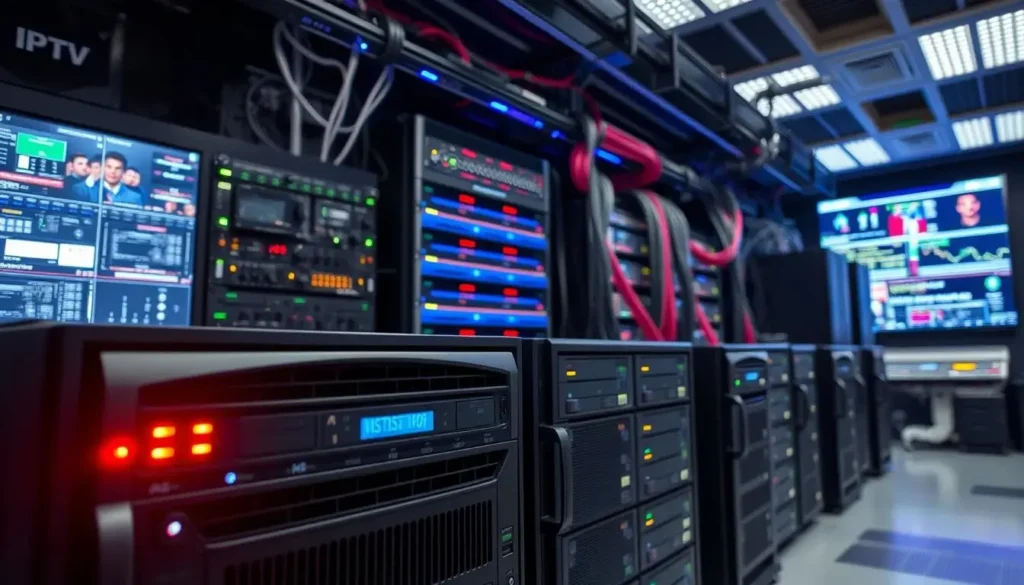
How Digital TV Headend Systems Process and Distribute Content
Your digital TV headend system follows a clear workflow to get content to your viewers. The process begins with signal reception from your various sources. Satellite receivers capture DVB-S2 signals, terrestrial tuners pick up DVB-T2 broadcasts, HDMI encoders grab local content, and IP connections stream content from the internet.
Once your headend receives these signals, it performs encoding and transcoding. This converts content into efficient formats like H.264 or H.265 that travel smoothly across your network. The system then multiplexes multiple channels into organized IP streams. These streams use multicast or unicast protocols to reach different rooms and devices throughout your facility.
The beauty of an IPTV headend architecture is its scalability. Adding new rooms or buildings requires only network capacity, not expensive new cable runs. Your system supports modern content delivery, including 4K video and adaptive bitrate streaming. Integration with middleware platforms gives you advanced features like custom channel guides, video-on-demand, and interactive services.
| System Component | Function | Input/Output Type |
|---|---|---|
| Satellite Receiver Module | Captures satellite broadcast signals | DVB-S/S2 Input |
| Terrestrial Tuner | Receives over-the-air broadcasts | DVB-T/T2 Input |
| HDMI Encoder | Converts local content for distribution | HDMI Input to IP Output |
| Encoding Engine | Transforms signals into network-ready formats | Multiple Formats to H.264/H.265 |
| Multiplexer | Combines channels into efficient streams | Single IP Stream Output |
| Distribution Manager | Routes content across network | Multicast/Unicast Delivery |
Your IPTV headend gives you complete control over content delivery. You decide which channels appear in which rooms. You manage bandwidth efficiently by adapting video quality based on network conditions. You apply encryption to protect premium channels. This level of control transforms how you deliver entertainment and information to your guests, patients, or employees.
Why Your Business Needs Professional Video Headend Systems
Your business demands reliable television delivery that keeps guests satisfied and operations running smoothly. Professional video headend systems deliver exactly what modern hospitality and commercial spaces require. Whether you manage a boutique hotel, hospital, university campus, or resort, investing in quality video headend systems transforms how you distribute content across your property.
Traditional cable setups create frustrating problems. Guests complain about pixelated images, frozen screens, and channels that work in some rooms but not others. Your staff spends countless hours troubleshooting equipment scattered throughout your building. Costs skyrocket as you purchase separate set-top boxes and multiple subscriptions for each room. Professional video headend systems eliminate these headaches by centralizing everything you need.
- Consistent channel quality across every room from first floor to penthouse
- Centralized management through a single interface for adding channels and updating programming
- Flexible architecture that scales from 50 rooms to 500+ rooms effortlessly
- Cost-effective expansion by sharing premium subscriptions across multiple rooms legally
- Future-proof technology that adapts to 4K content and new services through software updates
Your return on investment grows through reduced operational costs, higher guest satisfaction scores, and new revenue opportunities like pay-per-view services. Video headend systems create the competitive advantage your business needs in today’s market.
Comprehensive IPTV Headend Equipment for Hospitality and Commercial Spaces
Your business needs reliable broadcast headend equipment to deliver consistent video content across multiple rooms and locations. Whether you manage a hotel, hospital, corporate office, or resort, understanding your equipment options helps you make smart purchasing decisions. The right setup ensures your guests and employees enjoy uninterrupted access to entertainment and information.
Building a strong IPTV system starts with selecting quality components that work together seamlessly. Your broadcast headend equipment forms the backbone of content delivery. Each piece plays a specific role in capturing, processing, and distributing video signals to end users throughout your facility.
Broadcast Headend Equipment Components
Your broadcast headend equipment collection includes several essential parts. Satellite receivers capture signals from services like Arabsat and NileSat. Terrestrial tuners bring in local over-the-air broadcasts. Multiplexers combine multiple channels into organized streams. IP gateway modules convert broadcast signals into network packets. Redundant power supplies keep everything running during electrical problems.
You’ll also need rack-mounted chassis to organize all components neatly. Network switches with IGMP snooping capabilities handle multicast video traffic efficiently. These components work together in a 19-inch standard configuration that looks professional and operates reliably.
- DVB-S/S2 receivers for satellite content
- DVB-T/T2 tuners for terrestrial broadcasts
- IP output modules for network distribution
- Professional-grade network switching equipment
- Backup power systems for continuous operation
IPTV Encoder Solutions for Signal Processing
Your IPTV encoder solutions transform raw video into streamable content. Encoders handle different video sources depending on your needs. HDMI encoders let you broadcast content from Blu-ray players, computers, or cameras. SDI encoders work with professional broadcast equipment requiring higher quality standards.
Encoding standards affect how your content looks and performs. H.264 provides broad compatibility across devices. H.265 handles 4K content more efficiently using less bandwidth. You can adjust bitrates based on your quality requirements.
| Encoding Standard | Best Use | Bitrate Range | Quality Level |
|---|---|---|---|
| H.264 (AVC) | Standard HD channels | 4-6 Mbps | Good compatibility |
| H.265 (HEVC) | 4K and premium content | 2-4 Mbps | High efficiency |
| Adaptive bitrate | Variable network conditions | 2-10 Mbps | Auto-adjusting |
Your IPTV encoder solutions adapt to different situations. Premium 1080p content uses 8-10 Mbps for excellent picture quality. Standard HD uses 4-6 Mbps for balanced quality and bandwidth usage. Adaptive encoding automatically adjusts to network changes, ensuring smooth playback even when bandwidth fluctuates.
Choosing the right broadcast headend equipment and IPTV encoder solutions determines your system’s success. Quality components from trusted suppliers ensure reliable performance and long-term satisfaction for your business.
Seamless Streaming Headend Infrastructure for High-Traffic Environments
Your business needs a streaming headend infrastructure that performs flawlessly when hundreds of guests access content simultaneously. During peak hours—checkout time at hotels, visiting hours at hospitals, or major events at sports venues—your system must deliver consistent quality without buffering or interruptions.
The key to managing high-traffic demands lies in multicast distribution technology. This approach sends a single stream that serves unlimited viewers, rather than creating separate streams for each television. A 5 Mbps channel uses only 5 Mbps of bandwidth whether one person or one thousand people watch it. This efficiency is critical for properties handling massive simultaneous usage.
Your streaming headend infrastructure requires specific network components to function reliably:
- Managed switches with IGMP snooping to intelligently route multicast traffic
- Backbone capacity of 10 Gbps fiber connections between distribution closets
- Quality of service configurations that prioritize video during network congestion
- Redundant pathways that automatically reroute traffic if network links fail
Reliability features protect your operations during demanding periods. Server redundancy with automatic failover ensures your backup headend takes over within seconds if your primary system fails. Channel monitoring detects signal loss immediately and alerts your technical team. Battery backup systems protect critical headend components during power fluctuations, keeping your guests entertained without interruption.
Offline operation capabilities allow cached content to continue playing even when internet connectivity drops temporarily. This means your guests enjoy uninterrupted entertainment regardless of network conditions.
A properly designed streaming headend infrastructure maintains consistent performance when it matters most—during your highest-occupancy periods and peak guest demand.
Cost-Effective Cable TV Headend Alternatives That Cut Expenses by 70%
Traditional cable TV services drain your budget month after month. Your business pays recurring fees that never stop, no matter how many rooms or screens you operate. A cable TV headend system forces you into an endless cycle of monthly charges that can reach thousands of dollars annually. The good news is that modern IPTV technology offers a game-changing alternative that slashes your expenses dramatically.
Switching to a LAN-based system transforms your cost structure entirely. You invest once in quality equipment, then watch your expenses plummet. Most businesses recover their initial investment within 8 to 16 months through eliminated cable fees alone.
Eliminate Monthly Cable Fees with LAN-Based Systems
Traditional cable and satellite providers charge per-room monthly fees ranging from $15 to $40 per room. A 50-room hotel using standard cable TV headend boxes pays approximately $2,000 monthly in subscription costs. Over one year, that totals $24,000 just for basic service.
An IPTV encoder solution changes this equation entirely. You purchase one encoder unit for a one-time cost of $499. This single device handles the signal processing work that previously required dozens of expensive rental boxes. Your monthly expenses drop from hundreds to nearly zero.
- Traditional cable TV headend: $2,000+ per month
- IPTV encoder system: $499 one-time investment
- Annual savings: $23,500+
- ROI timeline: Less than 3 months
You own your cable TV headend infrastructure permanently. Unlike rental agreements that expire and renew with rate increases, your equipment remains yours indefinitely. Zero monthly licensing fees apply to the distribution technology itself.
Share Premium Channels Across Multiple Rooms
One premium subscription becomes available to every television on your network simultaneously. Connect a single DSTV, Canal+, or Bein Sports box to your encoder, and 100 or more televisions access that content at once. You eliminate the need to rent individual set-top boxes for each room.
Consider a practical scenario: Your 50-room property wants premium sports programming. Traditional cable TV headend pricing demands $25 monthly per box across 50 rooms, totaling $15,000 annually. Using an IPTV system with one premium subscription at $25 per month plus your encoder cost, your annual expense drops to approximately $300 plus the one-time equipment investment.
| Service Model | Monthly Cost | Annual Cost | Equipment Cost | Year 1 Total |
|---|---|---|---|---|
| Traditional Cable TV Headend (50 Boxes) | $1,250 | $15,000 | $0 | $15,000 |
| IPTV LAN-Based System | $25 | $300 | $499 | $799 |
| Annual Savings | $1,225 | $14,700 | $0 | $14,201 |
Your savings reach 90% when implementing this approach. Premium channels that once seemed financially out of reach become affordable luxuries for your guests.
Flexible subscription pricing lets you test services before committing to annual plans. Choose the option that works for your budget:
- 1 Month: 20€
- 3 Months: 35€
- 6 Months: 45€
- 12 Months: 65€
Annual commitments offer maximum savings while short-term options provide flexibility. You control your content investment completely. This approach operates within full legal compliance. You’re distributing legitimately subscribed content throughout your private property network, not circumventing licensing agreements.
A cable TV headend alternative powered by IPTV technology lets you provide premium entertainment experiences while slashing operational costs. Your guests enjoy diverse programming while your profit margins expand dramatically.
Multicast IPTV Distribution for Hotels, Hospitals, and Resorts
Multicast IPTV distribution represents the backbone of modern television delivery across commercial properties worldwide. When you choose this technology, you gain the ability to stream content to hundreds or thousands of rooms without overwhelming your network infrastructure. This efficiency makes multicast IPTV distribution the smart choice for properties of any size.
Understanding how multicast IPTV distribution works helps you see why it outperforms traditional alternatives. When a guest tunes to a channel in their room, the network sends a single stream to all viewers watching that same content. If fifty guests select the news channel simultaneously, your system delivers only one copy of that broadcast. Compare this to unicast streaming used by Netflix or YouTube, where each viewer requires a separate stream. For properties with hundreds of simultaneous viewers, unicast becomes impractical and expensive.
Your business benefits from multicast IPTV distribution across multiple industries:
- Hotels and resorts use multicast IPTV distribution to deliver welcome channels, local attraction guides, and premium content that generates extra revenue
- Hospitals rely on this technology for patient education, multilingual programming, and bedside control systems
- Residential buildings offer cable-replacement services with superior channel selection and reliability
- Corporate offices distribute company communications and training videos to common areas
- Educational institutions deploy campus-wide digital signage and emergency notification systems
Each industry prioritizes different features. Hotels focus on guest experience and ancillary income. Hospitals emphasize reliability and healthcare compliance. Residential properties concentrate on cost-effectiveness per unit. Your multicast IPTV distribution system adapts to these specific needs while maintaining network efficiency that traditional cable systems cannot match.
Multicast technology transforms how large properties deliver entertainment and information to their guests and staff members.
The Internet Group Management Protocol (IGMP) powers multicast IPTV distribution by allowing televisions to join specific broadcast groups. When viewers change channels, managed switches instantly stop delivering the previous stream and start the new one. This seamless switching happens without network congestion or performance loss, even across properties with thousands of endpoints.
Your decision to implement multicast IPTV distribution directly impacts operational costs and guest satisfaction. Systems serving properties across the UAE, Saudi Arabia, and Oman demonstrate that this technology scales reliably from small boutique hotels to large medical complexes and sprawling resort developments.
Advanced Video Processing Headend Features for Guest Experience
Your video processing headend system transforms basic television into a powerful engagement tool that strengthens guest relationships and drives revenue. Modern hospitality demands more than standard cable TV—your guests expect personalized, interactive experiences that reflect your property’s identity. Advanced video processing headend technology delivers exactly that by combining customization, entertainment, and service integration into one seamless platform.
These systems go beyond content distribution. Your video processing headend becomes a communication hub, a revenue generator, and a brand ambassador working 24/7 in every guest room. The right features can increase ancillary spending by 22% through strategic promotion and drive guest satisfaction through personalized interactions.
Customizable Welcome Screens and Branding
Your guests see a personalized welcome the moment they turn on the television. Instead of generic interfaces, your video processing headend displays custom welcome screens that greet guests by name, showcase your logo, and present information relevant to their stay.
- Personal greetings using guest registration data and multilanguage support (Arabic, English, French, Spanish, Chinese)
- Property branding with your logo, color schemes, and facility images
- Practical guest information including WiFi codes, local weather, check-out times, and prayer schedules
- Promotional content highlighting spa services, restaurant specials, and poolside events
- Cultural sensitivity features like Ramadan messages during holy periods
- Emergency information and safety compliance details
- QR codes for contactless services and mobile check-in options
Your front desk staff can update these screens through simple web interfaces without technical expertise. Real-time adjustments for special events, VIP arrivals, and seasonal promotions happen instantly across all rooms.
Premium Video-on-Demand and Revenue Generation
Your video processing headend transforms entertainment into profit through premium video-on-demand capabilities. This feature converts your in-room television from an expense into a dedicated revenue stream.
| Revenue Model | Implementation | Guest Impact |
|---|---|---|
| Pay-Per-View Movies | New releases and premium content priced $4.99-$7.99 | Automatic folio charging with guest approval |
| Advertising Pre-Rolls | 10-second ads before free content promoting on-property services | Increases spa bookings by 30% and restaurant covers by 20% |
| Local Partnership Revenue Sharing | Commission arrangements with desert safari firms and museums (15-25% margins) | Guests book experiences directly through their room television |
| Exclusive Premium Content | Arabic blockbusters, kids’ cartoons, and VIP exclusives with 45% profit margins | Enhanced entertainment variety increases guest satisfaction |
A 200-room hotel with 65% occupancy averaging 0.3 VOD purchases per occupied room per night at $5.99 each generates $85,000+ in annual VOD revenue. Your video processing headend manages this operation automatically.
Content flexibility allows you to upload your own videos, license content libraries from aggregators, and integrate Netflix and YouTube directly into your interface. Hotel-run channels broadcast in HD, display content by category, support television series playback, and include music on demand.
Beyond entertainment, your video processing headend connects guests to services. Online food ordering, in-room shopping, housekeeping requests, laundry services, and wake-up calls integrate seamlessly into the television interface. Guests track order status in real-time and complete one-key checkout—all through your advanced video processing headend system.
Professional IPTV Headend Installation and System Design Process
Setting up an iptv headend system requires careful planning and expert execution. A structured installation approach ensures your broadcast system operates smoothly from day one. When you choose a professional installation service, you gain access to engineers who understand every aspect of iptv headend deployment. This process transforms your vision into a reliable system that serves your guests or employees without interruption.
The installation journey begins with a comprehensive site survey. Your technical team visits your property to assess network capacity, equipment room space, and power availability. Engineers document your content requirements, building layout, and any special considerations unique to your location. This foundational step prevents costly mistakes later in the project.
Next comes detailed system design and planning. Your iptv headend installation includes:
- Equipment specifications matched to your channel lineup
- Network architecture diagrams showing signal distribution
- Rack elevation drawings for equipment room layout
- Cable schedules documenting every connection point
- Power calculations ensuring adequate electrical service
- Project timelines with clear milestones
During the physical installation phase, technicians mount your iptv headend equipment in standardized racks with organized cable management. They connect satellite dishes or antennas with precise alignment, integrate encoders for HDMI sources, configure network switches with proper settings, and install redundant power systems.
Channel mapping and processing comes next. Engineers assign logical channel numbers, configure electronic program guide data, set up decryption for premium channels, and optimize encoding for quality and bandwidth efficiency.
Your iptv headend system undergoes rigorous testing. Technicians verify picture quality, audio synchronization, channel responsiveness, and EPG accuracy. They conduct load testing with multiple simultaneous viewers to ensure reliable performance under real-world conditions.
Integration with existing property management systems connects your iptv headend to guest messaging platforms, emergency alert systems, and legacy infrastructure. IPTV middleware integration implements your branded user interface with custom applications and organized content.
Staff training ensures your team operates the system confidently. You receive hands-on training for front desk personnel, technical training for IT staff, detailed documentation, and ongoing support arrangements.
For immediate technical assistance with your iptv headend installation, contact us via WhatsApp +44 7380 310123. Professional installation is an investment in long-term reliability. Your iptv headend system delivers consistent performance when properly configured from the beginning.
Scalable Solutions for Different Business Applications
Your business operates in a unique environment with specific needs and challenges. A digital tv headend system designed for one industry may not work well for another. The good news is that scalable digital tv headend solutions exist for virtually every business type. From small boutique properties to large enterprises, you can find a headend system that fits your exact requirements. The core technology remains consistent, but the configuration, content selection, and user interfaces adapt to your specific industry demands.
Understanding how different sectors use these systems helps you make the right choice for your operation. Let’s explore the main business applications where digital tv headend technology delivers real value.
Hospitality and Resort Properties
Hotels and resorts depend on entertainment systems to keep guests happy and loyal. Your guests compare your TV service to what they have at home, so quality matters. A professional digital tv headend gives you the edge you need in this competitive market.
Hospitality properties require specific features that standard systems don’t provide:
- Premium content quality that matches guest expectations
- Intuitive interfaces requiring no instructions
- Multilingual support for international travelers
- Multiple-screen synchronization for sports events in restaurants and bars
- Flexible input switching for presentations in conference rooms
- Weatherproof outdoor displays around pools and recreation zones
- Specialized content like relaxation videos for spa areas and workout programs for fitness centers
- Revenue generation through pay-per-view and premium channel options
Your property size shapes what you need. Boutique hotels with 20 to 50 rooms require cost-effective, scaled-down configurations that still deliver professional results. Large resort complexes with 500 or more rooms need redundant systems, distributed architecture across multiple buildings, and sophisticated content management for different property zones.
Seasonal fluctuations affect your operational costs. A scalable digital tv headend system lets you adjust capacity during peak seasons and reduce expenses during slower periods, protecting your profit margins year-round.
Healthcare Facilities and Corporate Offices
Healthcare settings and corporate environments use the same digital tv headend technology, but their priorities differ significantly. Your facility’s unique needs drive the system configuration.
Healthcare facilities focus on patient comfort and education. Your priority is patient satisfaction during their stay. A healthcare-focused digital tv headend provides:
- Multilingual content serving diverse patient populations
- Patient education channels with health information and discharge instructions
- Integration with pillow speakers for bedside control
- Limited, family-friendly channel lineups
- Quiet hours programming with automatic volume reduction at night
- Emergency alert integration for hospital-wide notifications
- Compliance with healthcare privacy regulations and data security standards
Corporate offices emphasize internal communications and productivity. Your digital tv headend system serves different purposes throughout your facility:
- Lobby displays showing company news and visitor information
- Cafeteria and break room entertainment options
- Conference room integration for presentations and video conferencing
- Training room content delivery for employee development programs
- Digital signage throughout facilities for wayfinding and announcements
Corporate deployments often require compatibility with existing IT infrastructure, Active Directory authentication, and enterprise network security policies. Your digital tv headend system must work seamlessly within these constraints while maintaining reliability and performance.
| Business Type | Primary Focus | Key Features Needed | System Scale |
|---|---|---|---|
| Boutique Hotels (20-50 rooms) | Guest satisfaction and cost control | Basic premium content, intuitive interface, multilingual support | Small to medium |
| Large Resorts (500+ rooms) | Guest experience across diverse zones | Redundant systems, distributed architecture, multiple content channels | Large enterprise |
| Hospitals and Medical Centers | Patient comfort and compliance | Health education content, emergency alerts, privacy protection, bedside control | Medium to large |
| Corporate Offices | Internal communications and productivity | Company news displays, IT integration, employee training content, wayfinding | Small to large |
| Residential Buildings | Tenant satisfaction and retention | Diverse content options, basic features, cost efficiency | Medium |
| Educational Institutions | Information dissemination and learning | Emergency notifications, campus communications, classroom integration | Large |
| Shopping Malls | Retail support and visitor engagement | Promotional content, digital signage, emergency alerts | Medium |
| Sports Venues | Fan experience and event management | Live event broadcasting, multiple-screen synchronization, instant replays | Large enterprise |
The beauty of a modern digital tv headend solution lies in its flexibility. Whether you operate a small clinic, a sprawling resort, or a multi-floor corporate tower, the same core technology adapts to your needs. You gain the benefits of proven, mature technology regardless of your industry. Your investment works efficiently for your specific situation, scaling up or down based on your requirements and budget constraints.
Getting Started with Your IPTV Headend Solution
Moving forward with an iptv headend system requires a clear action plan. You’ll find that getting started involves four straightforward steps that professional providers guide you through systematically. Understanding this process helps you transition from consideration to implementation with confidence and clarity.
Your first step is to assess your current situation and define what you need. Document your existing TV system costs, including monthly cable or satellite fees and equipment rental charges. Identify pain points like guest complaints or limited channel options. Clarify your goals around cost reduction and desired features. Establish a realistic budget for both initial investment and ongoing operational expenses. This assessment phase helps you communicate clear requirements when consulting with providers.
Next, request consultations and proposals from qualified iptv headend specialists. Reach out to established providers serving your region. You can contact providers directly via WhatsApp +44 7380 310123 for immediate responses to initial questions. Reputable providers will ask detailed questions about your property size, existing network infrastructure, and content preferences. Evaluate multiple proposals by comparing provider experience, equipment quality, support arrangements, and scalability options.
Plan your implementation timeline carefully. Coordinate installation scheduling around your operational calendar to minimize disruption. Prepare your staff for the transition through advance communication and training. Most implementations for smaller properties complete within 2-4 weeks. Larger properties may require 6-12 weeks with phased rollouts.
Take advantage of flexible subscription options that reduce financial risk while you validate results:
| Subscription Period | Cost | Best For |
|---|---|---|
| 1 Month | 20€ | Initial service quality evaluation |
| 3 Months | 35€ | Seasonal trial periods |
| 6 Months | 45€ | Extended evaluation testing |
| 12 Months | 65€ | Maximum value after confirmation |
Professional iptv headend providers want your long-term success. Many offer guarantees and support commitments to ensure informed decisions aligned with your business objectives. Organizations like AL IMTEDAD provide one-year free support when working with them, and DIBSYS offers comprehensive solutions worldwide. You can reach additional support resources at sales@imtedad.com or solution@dibdvb.com.
Your path to implementation becomes manageable when you follow these systematic steps. Quality providers guide you through assessments, consultations, timeline planning, and flexible trial options. This structured approach minimizes risk while maximizing your return on investment in iptv headend technology.
Conclusion
Video headend systems have evolved from emerging technology into a proven standard for modern properties. Thousands of hotels, hospitals, and resorts worldwide have successfully switched from legacy cable systems to IP-based distribution. This shift validates both the reliability of the technology and the strong business case behind it. Your property can join these successful implementations and start seeing real results right away.
The benefits are clear and measurable. You’ll cut costs by 70% or more compared to traditional cable TV services. Your guests or patients will enjoy customizable interfaces and premium content options. Your staff will manage everything from one central location. Video headend systems give you the flexibility to grow as your property expands. The question is not whether to upgrade, but when you’ll make the move and which provider will help you get there.
Common concerns should not hold you back. Professional installers minimize downtime and can phase deployments to fit your schedule. Modern video headend systems feature intuitive management tools that your existing staff can operate after brief training. The rapid return on investment through eliminated cable fees means your system pays for itself. Flexible financing options make the capital investment manageable for any size property.
Take action today. Request demonstrations of video headend systems operating in properties similar to yours. Ask questions and explore options with qualified providers. Review detailed proposals and compare solutions. The path forward is clear. Assess your current costs, consult with experts, and implement a modern IPTV headend solution. Transform your television service from an operating expense into a strategic asset that reduces costs, improves guest satisfaction, and generates new revenue streams for your business.
FAQ
What exactly is an IPTV headend server and how does it differ from traditional cable TV headend equipment?
An IPTV headend server functions as the nerve center of your entire television distribution network, serving as the hardware and software combination that receives satellite signals, terrestrial broadcasts, HDMI inputs, and internet streams, then converts everything into IP packets for delivery across your existing network infrastructure. Unlike traditional cable TV headend systems that rely on RF distribution through coaxial cabling, your IPTV headend eliminates the need for dedicated cable runs throughout your property. The digital TV headend server manages channel lineups, applies encryption where needed, handles user authentication, and ensures consistent quality across all endpoints—whether you’re operating a small boutique hotel or a large hospital complex.
How does an IPTV encoder solution work, and what types of encoders do I need for my property?
IPTV encoder solutions transform raw video signals into streamable content that your system can distribute. HDMI encoders allow you to broadcast local content by connecting devices like Blu-ray players for in-room movies, computers for conference presentations, or cameras for live event coverage of your property’s functions. SDI encoders handle professional video sources with broadcast-quality requirements for more demanding applications. Your broadcast headend equipment uses encoding standards such as H.264 (AVC) for broad compatibility, H.265 (HEVC) for 4K content with superior bandwidth efficiency, and emerging AV1 codec support. Bitrate considerations matter: higher bitrates (8-10 Mbps) deliver premium 1080p quality, moderate bitrates (4-6 Mbps) provide standard HD performance, and adaptive bitrate encoding automatically adjusts to your network conditions.
What are the main components of a complete broadcast headend equipment installation?
Your broadcast headend equipment requires several essential components working together: DVB-S/S2 satellite receivers that capture free-to-air and encrypted channels from satellites like Arabsat, NileSat, or Galaxy; DVB-T/T2 terrestrial tuners for local over-the-air broadcasts including news, weather, and network programming; RF modulators for legacy integration if needed; multiplexers that combine multiple channels into efficient transport streams; IP gateways that convert traditional broadcast signals into network-ready packets; rack-mount chassis organizing all components in standard 19-inch configurations; redundant power supplies ensuring uninterrupted operation; and network switches optimized for multicast video traffic with IGMP snooping capabilities. Equipment specifications that matter include input signal compatibility, processing capacity (how many channels you can handle simultaneously), output formats and bitrates, heat dissipation requirements, and mean time between failures (MTBF) ratings indicating reliability.
How does multicast IPTV distribution reduce bandwidth requirements compared to traditional streaming?
Multicast IPTV distribution enables incredibly efficient bandwidth utilization where a single stream serves unlimited viewers rather than creating individual unicast streams for each television. When you implement multicast distribution, a 5 Mbps channel consumes only 5 Mbps of network bandwidth whether one person or one thousand people are watching it simultaneously. This contrasts sharply with unicast streaming (used by Netflix and YouTube) where each viewer requires a dedicated stream, multiplying bandwidth requirements by viewer count. For high-traffic environments like hotels during checkout time, hospitals during visiting hours, or sports venues during major events, multicast efficiency is absolutely critical to maintaining consistent performance and preventing service degradation.
What infrastructure requirements do I need for reliable streaming headend infrastructure?
Your streaming headend infrastructure requires several key components: managed switches with IGMP snooping to intelligently route multicast traffic to appropriate destinations; sufficient backbone capacity between distribution closets (typically 10 Gbps fiber connections for larger properties); quality of service (QoS) configurations that prioritize video traffic during network congestion; and redundant pathways that automatically reroute traffic if a network link fails. Professional installations include server redundancy with automatic failover (if your primary headend fails, a backup takes over within seconds), channel monitoring that detects signal loss and alerts your technical team immediately, and offline operation capabilities where cached content continues playing even if internet connectivity is temporarily lost. Battery backup systems (UPS) for critical headend components ensure continuous operation during brief power fluctuations, protecting your guests’ or patients’ experience and your property’s reputation.
How much money can I actually save by switching from traditional cable TV headend to an IPTV system?
The financial savings are dramatic and immediate. Traditional cable and satellite providers typically charge per-room monthly fees ranging from $15-$40 per room depending on package tier, meaning a 100-room hotel pays $18,000-$48,000 annually just for basic service. With your LAN-based IPTV system, you invest in headend equipment once (typically $5,000-$25,000 depending on channel count and features), then pay only for the content sources you choose—perhaps one premium satellite subscription at $200/month, some free-to-air channels costing zero, and local terrestrial broadcasts costing nothing. Your annual costs drop from $18,000+ to under $3,000, representing 70-85% savings. Most properties recover their initial equipment investment within 8-16 months through eliminated cable fees alone, and these aren’t promotional rates that increase—once you own your headend equipment, it’s permanently yours with no recurring licensing fees for the distribution technology.
Can I legally share one premium channel subscription across multiple rooms in my property?
Yes, absolutely. You can legally distribute legitimately subscribed content throughout your private property network through your IPTV headend system. Instead of renting 50 or 100 set-top boxes from your cable provider, you connect one premium set-top box (from providers like DSTV, Canal+, or Bein Sports) to an HDMI encoder in your headend, and that single channel becomes available to every television on your property simultaneously. A practical example: a 100-room hotel wanting to offer premium sports channels would traditionally pay for 100 boxes at $25/month each ($30,000 annually), but with your IPTV headend you pay for one subscription ($25/month = $300 annually) plus a one-time encoder cost ($500). Your savings amount to $29,500 in year one and $29,700 every year thereafter. This approach is completely legal—you’re not pirating content, you’re simply distributing legitimately subscribed content throughout your private property network.
What subscription pricing options are available for IPTV services?
IPTV service providers offer flexible subscription options allowing you to choose commitment levels that match your business needs: 1 Month subscriptions at 20€ provide short-term testing to evaluate service quality and guest response before major commitments; 3 Month plans at 35€ allow seasonal trial periods to assess performance across different occupancy levels; 6 Month subscriptions at 45€ cover extended evaluation periods with meaningful savings; and 12 Month commitments at 65€ offer maximum value once you’ve confirmed the solution meets your requirements. These affordable tiers minimize financial risk while you validate that the video headend system delivers promised benefits, and the flexibility means you’re never locked into services that don’t perform.
How do customizable welcome screens and branding features benefit my property?
Your video processing headend system creates memorable first impressions through customized welcome screens displaying personalized greetings using guest registration names (“Welcome Ms. Johnson to Oceanview Resort”), your property logo and branded color schemes, background images showcasing your facilities (pool, spa, restaurants), and practical information like WiFi credentials, local weather, and check-out time. These welcome screens support multilingual display—automatically detecting guest preferences or allowing manual selection of Arabic, English, French, Spanish, Chinese, or any language your market requires. You can display culturally relevant greetings (Ramadan messages during holy periods, holiday greetings, local festival information) that demonstrate cultural sensitivity. Beyond aesthetics, these screens serve strategic purposes: promoting on-property amenities (spa treatments, restaurant specials, poolside happy hours) that data shows increase ancillary spending by 22% when prominently featured; displaying QR codes for contactless services; and providing emergency information for safety compliance. Your front desk staff can update welcome messages and promotional content through simple web interfaces without technical expertise.
What revenue-generation opportunities does premium video-on-demand create?
Your video processing headend becomes a profit center through premium video-on-demand capabilities offering multiple revenue streams. You can offer new-release movies at $4.99-$7.99 per view, specialized content (fitness videos, meditation sessions, kids’ programming), local cultural content (destination guides, cooking demonstrations featuring your chef), and adult entertainment in appropriate markets. Revenue models include direct pay-per-view charges added to guest folios automatically, advertising pre-rolls before free content (promoting your spa, restaurant, or paid local partners), and commission arrangements with local tour operators where you earn 15-25% of bookings made through your TV interface. Real revenue examples demonstrate that a 200-room hotel with 65% occupancy averaging 0.3 VOD purchases per occupied room per night at $5.99 per purchase generates $85,000+ in annual VOD revenue; promotional effectiveness for on-property services can increase spa bookings by 30% and restaurant covers by 20% according to hospitality industry data.
What does the professional IPTV headend installation process involve?
The professional installation process follows systematic methodology: Site survey and requirement analysis where engineers assess your existing infrastructure (network capacity, equipment room space, power availability), understand your content requirements (which channels, languages, custom content), document your property layout, and identify special considerations. System design and planning creates detailed specifications including headend equipment selections, network architecture diagrams, rack elevation drawings, cable schedules, power calculations, and project timelines. Installation and rack setup involves physical deployment with proper cable management, connecting satellite dishes with precise alignment, integrating encoders, configuring network switches with VLAN and multicast settings, and implementing redundant power. Channel mapping and processing configures your channel lineup and electronic program guide (EPG) data. Testing and quality verification checks picture quality, audio synchronization, channel changing responsiveness, and EPG accuracy through load testing. Integration with existing systems connects your IPTV headend to property management systems, building management systems, and legacy systems. IPTV middleware integration implements your user interface with branding and custom applications. Training and handover ensures your staff can operate the system, with documentation and ongoing support arrangements. You’ll have direct access to technical support teams via WhatsApp +44 7380 310123 for immediate assistance. Most implementations for properties under 200 rooms complete within 2-4 weeks; larger properties may require 6-12 weeks with phased rollouts.
How does IPTV headend technology specifically benefit hospitality and resort properties?
Hotels and resorts require digital TV headend systems that deliver premium content quality (guests compare your service to their home entertainment systems), offer intuitive interfaces (guests shouldn’t need instructions), provide multilingual support (international travelers expect their language options), and generate additional revenue (pay-per-view, premium channels, promotional opportunities). Resort properties add unique requirements: outdoor display areas around pools requiring weatherproof solutions, conference and event spaces needing flexible input switching for presentations and live broadcasting, spa and fitness areas with specialized content (relaxation videos, workout programs), and restaurants/bars with sports packages and multiple-screen synchronization for major events. Boutique properties (20-50 rooms) benefit from scaled-down headend configurations delivering professional results without enterprise-level investment, while large resort complexes (500+ rooms) require redundant systems, distributed architecture across multiple buildings, and sophisticated content management for different property areas (family zones with kids’ content, adult pools with different programming, conference centers with business news). Seasonal considerations for resort properties with occupancy fluctuations mean systems that scale capacity during peak seasons and reduce operational costs during slower periods.
How do healthcare facilities benefit from IPTV headend solutions?
Healthcare facilities using video headend systems prioritize patient comfort and education through multilingual content serving diverse patient populations, patient education channels with health information and discharge instructions, integration with pillow speakers and nurse call systems for bedside control, and compliance with healthcare regulations regarding patient privacy and data security. Specialized features include limited channel lineups focused on family-friendly content, quiet hours programming with automatic volume reduction during nighttime, and emergency alert integration for hospital-wide notifications. Your IPTV headend infrastructure ensures reliable content delivery meeting strict healthcare uptime requirements and supporting therapeutic benefits that contribute to patient satisfaction scores—factors increasingly important in value-based reimbursement models.
What advantages do corporate office installations gain from IPTV headend systems?
Corporate office applications focus on internal communications and common area entertainment through lobby displays with company news and visitor information, cafeteria and break room entertainment, conference room integration for presentations and video conferencing, training room content delivery for employee development, and digital signage throughout facilities for wayfinding and announcements. Corporate deployments often integrate with existing IT infrastructure and security policies, requiring compatibility with enterprise network standards, Active Directory authentication, and corporate firewall configurations. Your digital TV headend provides centralized control enabling company-wide communications (emergency alerts, important announcements), training distribution (onboarding videos, compliance training, professional development), and employee engagement through well-curated content in break areas.
How should I assess my current situation before choosing an IPTV headend provider?
Begin by documenting your existing TV system costs including monthly cable or satellite fees, equipment rental charges, and service call expenses. Identify specific pain points: guest complaints about service quality, limited channel selection, inability to add custom content, outdated equipment, or operational challenges. Clarify your goals—whether you prioritize cost reduction, desire new features, have specific implementation timelines, or need to stay within particular budget ranges for both initial capital investment and acceptable ongoing operational costs. This assessment helps you articulate clear requirements when consulting with providers and ensures you evaluate proposals against your actual business priorities rather than generic features.
What should I look for when evaluating proposals from different IPTV headend providers?
When comparing proposals, evaluate multiple dimensions beyond just price: provider experience serving similar properties (request references and case studies from comparable installations), equipment quality (brand names, warranty terms, expected equipment lifespan), support arrangements (response times, on-site versus remote support availability, after-hours accessibility), and scalability (how easily you can add rooms or features as your property evolves). Request detailed proposals showing equipment costs itemized separately, installation labor charges broken down by phase, and any ongoing support fees with clear explanation of what’s included. Professional providers offer transparent pricing and are happy to explain their costs, technology choices, and competitive advantages compared to alternatives.
Can I implement an IPTV headend system without disrupting my current operations?
Yes, professional installers minimize operational disruption through careful planning and flexible implementation approaches. For occupied properties, installation can proceed room-by-room during low-occupancy periods, with occupied rooms maintained on legacy service during the transition. Network upgrades can be scheduled during low-traffic times (typically early morning hours or specific days), and modern IPTV systems support gradual channel migration allowing guest access to new system while older system remains operational. Phase-based rollouts allow you to test the new system in limited areas (perhaps a single floor or wing) before property-wide deployment, identifying any issues in controlled environments. Most implementations for properties under 200 rooms complete within 2-4 weeks from project kickoff to full operation with minimal guest impact.
What training and support do IPTV headend providers typically offer?
Professional providers include comprehensive training and support as standard: hands-on training for front desk personnel on content management and guest-facing features, technical training for IT staff on troubleshooting and system monitoring, detailed documentation including network diagrams and configuration details, and ongoing support arrangements with defined response times. Many providers offer one-year free support programs covering any issues arising from installation, with escalation paths for problems requiring specialized expertise. Direct contact channels (such as WhatsApp +44 7380 310123) ensure you can reach support teams quickly when questions arise, and quality providers typically provide remote support for configuration issues and on-site support for hardware problems.
How quickly will my IPTV headend investment pay for itself?
The ROI timeline depends on your specific situation but typically ranges from 8-16 months through eliminated cable fees alone. For a 100-room property paying $30,000 annually ($25/month per room for cable service) switching to an IPTV system with $15,000 equipment investment and $3,000 annual content costs, you save $27,000 in year one—meaning the equipment pays for itself in approximately 6.7 months. This calculation includes only eliminated cable fees; additional ROI comes from revenue generation (video-on-demand, premium channel charges), operational efficiencies (reduced service calls, centralized management), and ancillary spending increases (22% lift on amenity bookings from TV-based promotions). Beyond the financial payback, you gain competitive advantages through superior guest experience,